
Space Creators and Space Invaders
Scouting Andy Rojas (Club Sport Herediano) and Andrey Soto (Deportiva San Carlos) in their clash on September 13, 2023 in the Primera División - Costa Rica.

Recognizing the Potential of a Space
There are two types of players in the world of football. There are an infinite number of player types in the world of football. The discussion that follows focuses only on two types though.
Space Creators: Players who recognize potential space and manipulate the opposition through their movement in order to make said space accessible.
Space Invaders: Players who recognize accessible space, the realized form of potential space.
Neither type of player works without the other; they are classic character foils. In addition, both Space Creators and Space Invaders are qualified to fulfill both definitions. A Space Creator can only recognize the potential of a space by understanding how their teammate, necessarily a Space Invader, can take advantage of it once it has been realized. A Space Invader can only access a realized space if they recognize the potential of a space before their teammate, necessarily a Space Creator, realizes the space for them since it is rare for space to open up without it being closed down quickly by the opposition.
Accessing a Realized Space
With the theory introduced (recognizing and creating a space for discussion), two players can now be brought into the conversation (accessing the discussion space with scouted examples).
Andy Rojas - Space Creator
17 years old / Costa Rican / Lined up as the Right Striker in a 4-4-2 system for this match
The most common way for a Space Creator to realize a potential space is to make off-the-ball runs. Drawing a defender towards yourself and then making a quick run that drags the defender away from their defensive cohort and out of position. This is where you create exploitable gaps in the opposition’s Out-Of-Possession shape. Areas for Space Invaders to access and receive.

Space Creators can also get involved in the play after realizing spaces that Space Invaders access. Rojas usually likes to be the second passer in third-man-runs, moving to receive the ball from one teammate and quickly playing the ball to a third teammate (he is the second) who has accessed the space he created by moving to receive the initial pass. When a Space Invader quickly accesses a space that has been realized by a Space Creator, the pair can manufacture an overload, which provides great benefit in areas like ball progression or chance creation.

As touched on before, Space Creators by default must also possess qualities of Space Invaders. This means, at times, Space Creators realize space and then access that space themselves. Rojas demonstrates how this concept can manifest using a few different techniques.

Other Observations
Highlights
Likes to stay high and central in possession, stretching the defense vertically
Gives him good opportunities to make those in-to-out runs, or drop to receive
Quick release when shooting. Gets the ball out of his feet before defenders can close him down.
Areas to Work On
Likes to create space with off-ball runs, but should look to get involved in more third-man-runs.
Similar to the above point, should show more desire to be on the ball and be part of the play.
Andrey Soto - Space Invader
20 years old / Costa Rican / Lined up as the Left Winger in a 4-2-3-1 system for this match
In classic foil fashion, seeing as one of the most common ways for a Space Creator to see space realized is in-to-out runs, a Space Invader can access those spaces by making out-to-in runs. These rotations pull opposition structures apart, creating confusion and exploitable gaps, as discussed previously.

One of the most dangerous ways to hurt the opposition is to attack them in transition, When a team loses the ball, they are oftentimes out of position, leaving dangerous gaps for Space Invaders to access. Soto thrives in these situations, always looking ahead at accessible spaces. When a forward drops in, there is space in behind. When a teammate drifts wider, space can open up centrally. Soto can also act as the furthest man forward, stretching the defense back before dropping into the space left in front of them.

In possession, Soto wants to come inside and combine in the half-spaces. Accessing those spaces tends to draw multiple defenders, creating space elsewhere for teammates to access. By playing first as a Space Invader, he becomes a Space Creator.
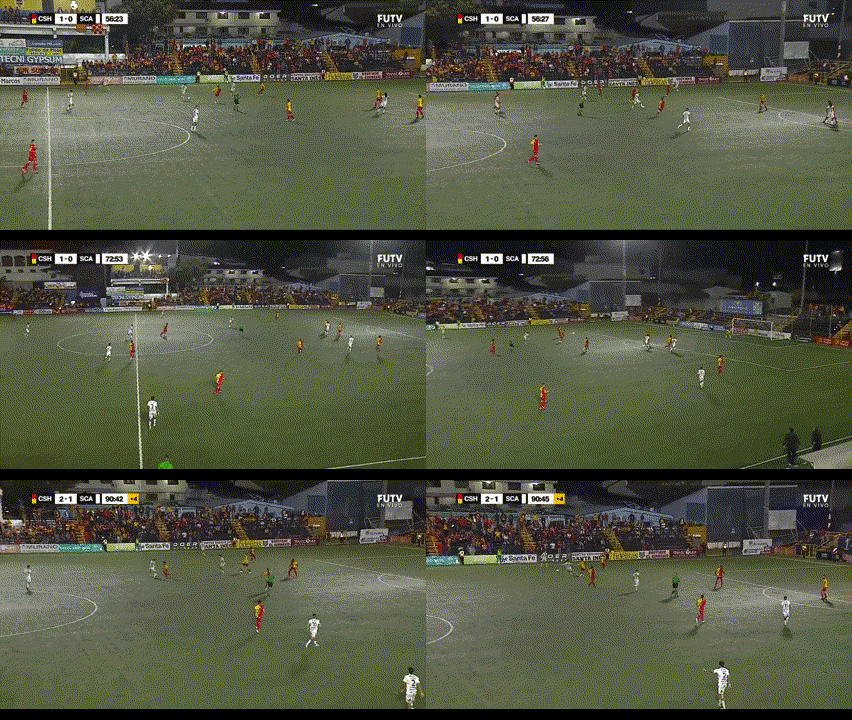
Soto, as a natural Space Invader, will also look to be a Space Creator for himself when he is isolated and sees the opportunity to do so. This often takes place when he receives the ball wide, looking to engage and fix a defender in an orientation that provides gaps. Soto doesn’t always need to beat his man as long as he can create enough separation to deliver a final ball.

Other Observations
Highlights
Direct and aggressive. Always looking to drag the attack forward with him.
Likes to look for how best to create for teammates. Good final ball.
Areas to Work On
Should work on his finishing. Not consistent even though some shots are decent.
Likes to combine quickly, but would benefit from recognizing moments to play a bit slower.
Data Check
Thank you to Ben Griffis (@BeGriffis) for providing this Wyscout data through his “Soccer Prospect Research & Radar Creation” web app found here:
https://football-prospect-research-made-by-bengriffis.streamlit.app/
Andy Rojas
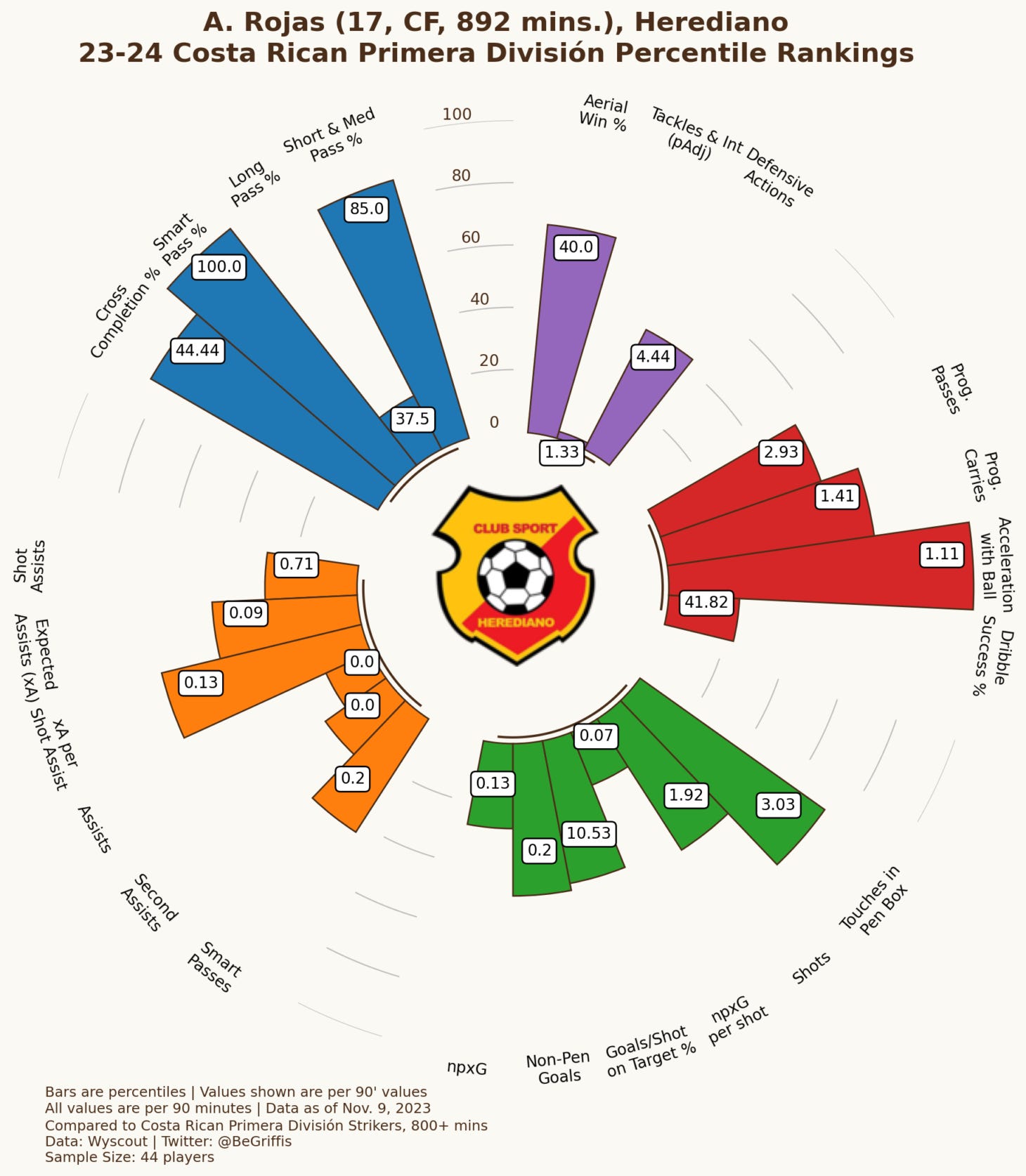
Andy Rojas’ passing numbers stand out the most here. He has a 100% completion rate of smart passes but only attempts 1 about every 2 games on average.
Smart Pass: A creative and penetrative pass that attempts to break the opposition's defensive lines to gain a significant advantage in attack. (from Wyscout)
He has a high completion percentage of 85 in short and medium passes, which is what you want from your Space Creator striker as he links up with teammates to unlock defenses. Unfortunately, not a lot of these passes are progressive passes (only 2.39 per 90) nor are they shot assists (0.71 per 90) or second assists (0 per 90). This indicates that these short and medium passes are either not in the final third, where shots are generated, or not completed with an intent to penetrate the opposition structure as much as to circulate the ball. His cross completion percentage is good among forwards but we don’t know how many crosses this is based on.
Most of these points back up the previous analysis that Rojas makes excellent contributions off the ball in possession (those stats are not present here) but would do well to find ways to incorporate himself more on the ball.
Andrey Soto
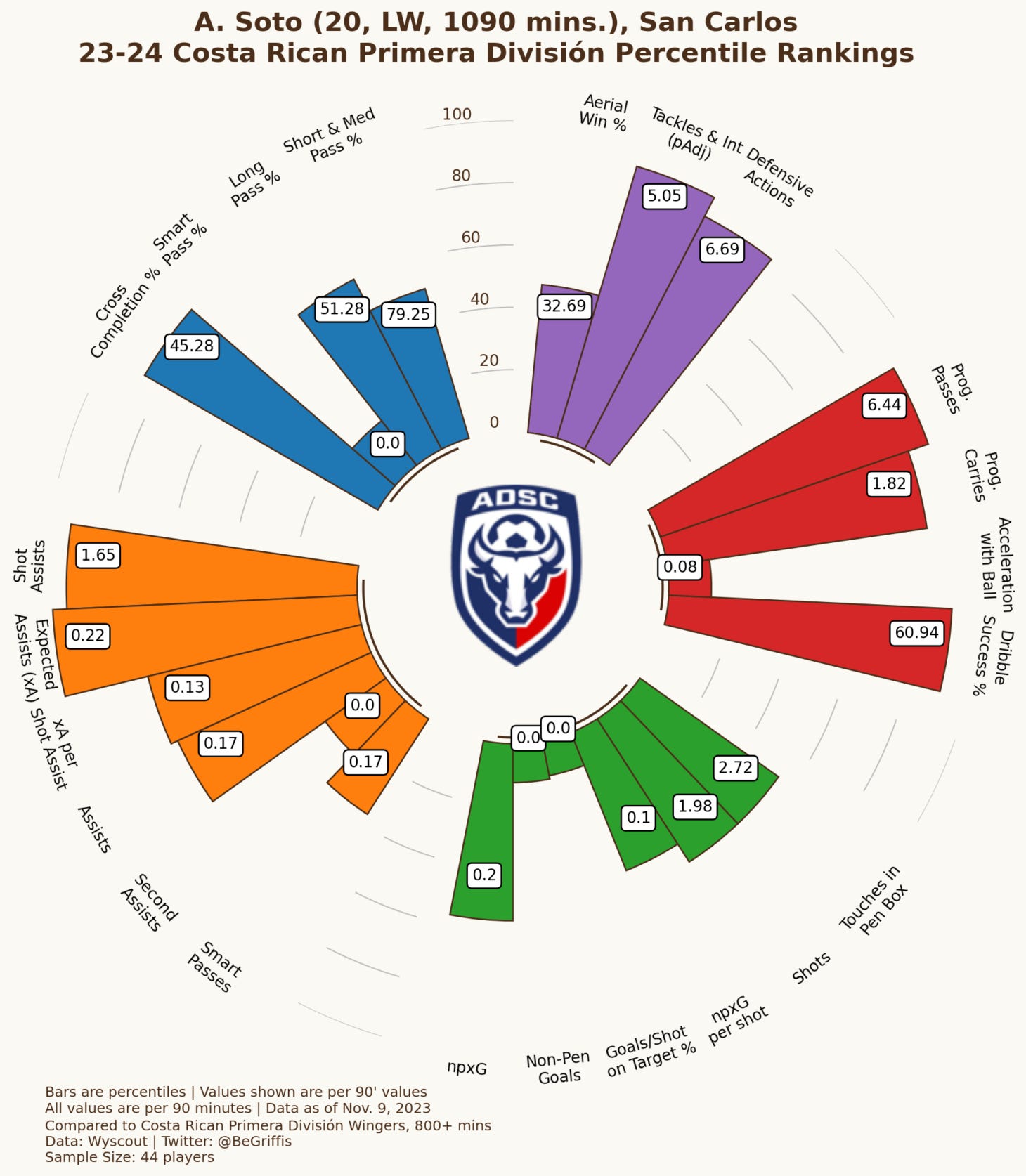
Once again we see the foil at work. Where Rojas appears to be missing in the data for on-ball actions, Soto is bountiful. He produces 6.44 progressive passes and 1.82 progressive carries per 90, which are in about the 90th and 80th percentile among forwards in the league, respectively. Soto also exhibits a high dribble success rate, again in about the 90th percentile. It is very clear that Soto wants to move the ball towards his goal and knows how to do so. What is also apparent is that Soto thrives in final actions. High metrics (among the 90th and 100th percentile) in shot assists, xAssists, and cross-completion percentage demonstrate Soto’s determination and ability to create goal-scoring opportunities from the spaces he accesses.
It is also worth noting Soto’s commitment to out-of-possession play, having high metrics in defensive actions as well as tackles and interceptions.